
When ABPP Follows Release
The Alabama Bureau of Pardons and Paroles is the statewide parole and probation agency. For Jefferson County release research, ABPP is relevant when the person has left ADOC custody but remains under parole, probation, mandatory supervision, a pending parole certificate, or a revocation-related process. That is different from being held in Jefferson County Jail - Birmingham, Jefferson County Jail - Bessemer, or the Birmingham Police Detention Division.
ABPP's public material is fragmented by function. Hearing schedules and hearing-result posts can show that the Board considered a case and whether parole was granted, denied, or continued. The Public Information Unit handles general questions about parole eligibility, hearing dates, hearing results, and people granted parole but not yet released. The Docket Unit's workflow includes Intake, File Room, Final Review, Setting, and Parole Certificates/Releases, which explains why a grant is not always the same thing as immediate physical release.
Confirming Parole or Probation Status
Start with the custody source, then move to supervision. The Jefferson County release hub can help separate county jail, ADOC, federal, and ICE paths from ABPP supervision. If the person was sentenced to ADOC, check ADOC while current and preserve any minimum-release or parole-consideration fields. After release or a parole hearing, use ABPP's public hearing pages, Public Information Unit, VNS, court records, and the records-request page.
- Search ABPP scheduled hearings or the events calendar for upcoming parole-related dates.
- Review ABPP hearing-results posts for the hearing date and outcome, including granted, denied, or continued.
- Use the Public Information Unit for general eligibility, hearing-date, result, and granted-but-not-yet-released questions.
- Use court records to confirm probation terms or revocation activity tied to a Jefferson County case.
- Submit an ABPP public-record request when a public record is needed and not already available online.
Source image from ABPP public-record request materials:
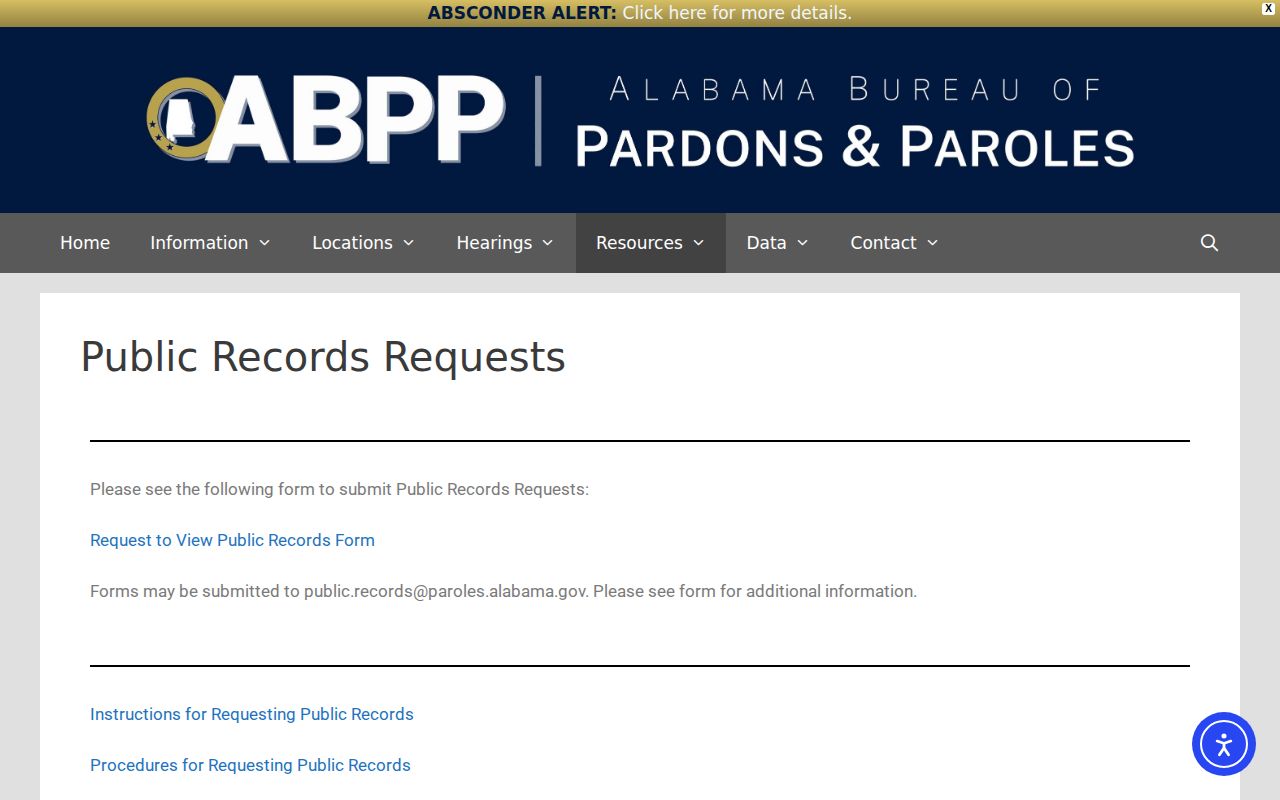
ABPP Records and Contact
ABPP lists statewide contact and public-record request channels. The research identifies the agency address as 301 S. Ripley St., Montgomery, Alabama, the main phone as 334-242-8700, general questions at questions@paroles.alabama.gov, and public-record requests at public.records@paroles.alabama.gov. Use these for ABPP records, while jail release dates remain with the jail or court record and ADOC historical release records remain with ADOC.
Alabama Bureau of Pardons and Paroles
301 S. Ripley St.
Montgomery, AL
334-242-8700
ABPP Public Records
Request to View Public Records form
public.records@paroles.alabama.gov
Use for public ABPP records not available through hearing schedules or result posts.
What ABPP Records Can Show
ABPP records are most useful when a Jefferson County reader is trying to reconcile a parole grant, ADOC release, probation supervision, or revocation. ABPP's parole FAQ says eligibility consideration is calculated under Alabama Code Section 15-22-28(e), and that sentence, offense, county-jail time, good-time eligibility, time served, and sentencing-court orders can affect the date. Once calculated, the inmate receives a letter with a parole consideration eligibility date or set date by month and year.
| ABPP Source | Use It For |
|---|---|
| Scheduled hearings and events | Finding upcoming parole hearing dates and cancellations. |
| Hearing-results archive | Checking whether the Board granted, denied, or continued a parole hearing. |
| Public Information Unit | General eligibility, hearing-date, result, and grant-before-release questions. |
| Public-record request | Requesting public ABPP records that are not posted online. |
Hearing Results Are Not the Whole Release
ABPP hearing-result posts are useful public evidence, but they are not the same thing as a physical release record. A result can show that a hearing occurred and whether parole was granted, denied, or continued. It may not show whether the person has completed final processing, received a parole certificate, satisfied conditions, or left ADOC custody. That distinction is why the Public Information Unit matters for a Jefferson County reader who sees a grant online while the person still appears in a current ADOC or transfer status.
The Docket Unit description also matters here. ABPP says the unit includes functions such as Intake, File Room, Final Review, Setting, and Parole Certificates/Releases. Those functions explain the administrative path between ADOC entry, parole eligibility calculation, hearing setting, denial letters, final review, and certificate/release work. When a family member or records requester is trying to confirm a Birmingham-area release, the safer wording is "parole granted," "hearing scheduled," or "under supervision" only when the matching ABPP or court record supports that exact status.
VNS, Court Records, and Local Supervision
For an ADOC-sentenced person, Alabama VNS can be part of the release-notification picture, while ABPP handles parole and probation supervision records. VNS should not be treated as a full public parolee search or as a substitute for the court file. The court record still explains the sentence, probation terms, revocation proceedings, county-jail time, and the division handling the case. This is especially important in Jefferson County because Birmingham and Bessemer records can route through different court contacts even though a user may remember only the county jail location.
When the person was held locally before ADOC transfer, pair the county jail record with ADOC and ABPP. The jail record can show local booking, bond, release, or transfer. ADOC can show current custody fields while the person is incarcerated and provides a separate public-record request route after release. ABPP can address parole eligibility, hearing dates, hearing results, and public supervision records. A complete release confirmation may need all three sources because each one controls a different part of the timeline.
| Question | Best Source |
|---|---|
| Was parole considered or granted? | ABPP schedules, events, and hearing-results archive. |
| Has the person physically left ADOC? | ADOC current record before release, VNS notice where eligible, or ADOC records request. |
| What are the probation or revocation terms? | The sentencing or revocation court record. |
| Is a public ABPP record available? | ABPP Public Information Unit or ABPP public-record request form. |
Birmingham-Area Reentry Context
Jefferson County also has local reentry and custody details that can be confused with ABPP supervision. The Sheriff's IGNITE page describes in-jail education, accountability, and reentry preparation, including a GED testing site inside the jail. That is local jail programming, not proof that ABPP supervision exists after release. Birmingham city jail property and document questions also belong to the actual holding facility, not ABPP, if the person was held municipally rather than in state custody.