
Projected vs Actual Release Date
In Jefferson County records, "release date" and "scheduled release date" are not interchangeable. The Tyler jail detail page can show a Booking History Release Date when a specific booking has ended. The Tyler result list can also show a Scheduled Release Date field, but that field may be blank or may not apply to a pretrial booking. For Alabama prison sentences, ADOC uses the label "Minimum Release Date" for the earliest scheduled date an inmate can be released to probation or end of sentence.
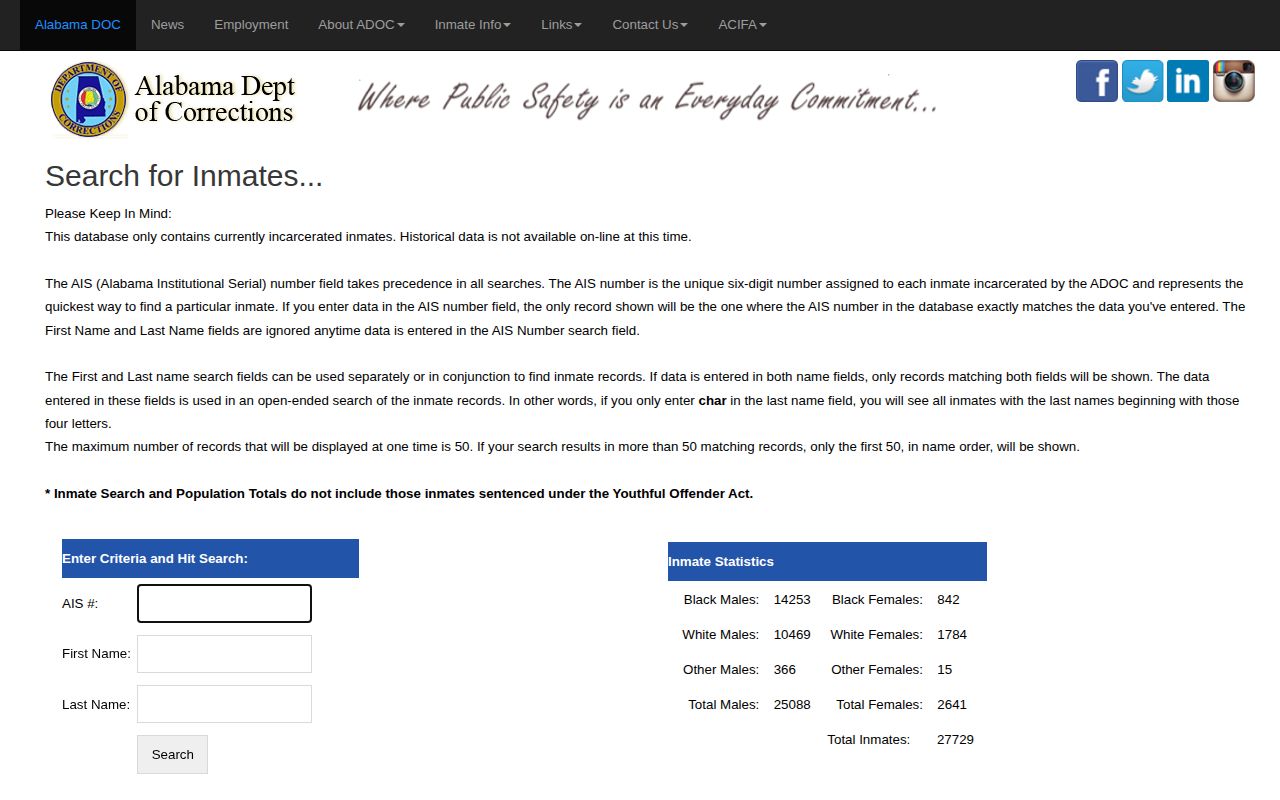
For a county jail booking, use the Jefferson County Tyler detail page to confirm whether a Release Date has populated. For a state-prison sentence, use ADOC while the person is current, because ADOC states that its public inmate search contains currently incarcerated inmates only and does not provide historical data online.
The county jail Scheduled Release Date field is most useful as a warning that the booking may have a planned end date, but it is not the same as a discharge certificate. A person can be released earlier by bond or pretrial release, later because a hold remains, or transferred to another authority even though the Jefferson County booking ends. By contrast, ADOC's Minimum Release Date is tied to a state sentence calculation and can point to release to probation or end of sentence. Both fields are date clues; neither should be read without the custody type, prisoner type, court status, and any transfer or hold information.
How to Find a Jefferson County Inmate's Projected Release Date
Start with the system that actually holds or sentenced the person. Jefferson County has two county jail locations, a separate Birmingham city jail, ADOC facilities in the county, community corrections, federal overlays, and immigration-custody possibilities. A release date from the wrong system can be misleading.
- For a Jefferson County jail booking, search the sheriff's Tyler Inmate Inquiry by name, subject number, or booking number. Narrow by booking date range or jail location if there are multiple matches.
- Open the booking detail and match the booking number and booking date. Look for Release Date, Scheduled Release Date, Prisoner Type, Facility, Total Bond Amount, bond rows, charges, and court fields.
- If the person is a pretrial detainee, do not expect a fixed sentence-release date. Confirm bond, pretrial release, court status, or transfer through the jail, Pre-Trial Release Office, and court record.
- For a sentenced ADOC prisoner, search ADOC by AIS number if available. ADOC says AIS takes precedence; name searches can be open-ended and display a maximum of 50 records.
- On the ADOC record, look for Minimum Release Date, County Jail Time, Good Time Received, Good Time Revoked, Total Term, sentence type, and Parole Consideration Date.
- If a Jefferson County sentence release date appears wrong, check county-jail time with the correct Jefferson County Circuit Clerk division because ADOC says the circuit clerk prepares county-jail-time time.
- For parole-related timing, use ABPP hearing schedules, hearing results, and Public Information Unit contacts. A Parole Consideration Date is not the same as a release date.
- For a formal historical release record after the person leaves ADOC custody, use ADOC's written public-record request process instead of relying on the current-inmate search.
The named-person search workflow on Jefferson County released inmates can help separate county jail release, ADOC release, federal release, ICE custody, and court-disposition questions before a date is treated as final.
Source image from the project manifest: ADOC's inmate search is the state source to check while a sentenced Alabama prisoner remains current in custody.
Good Time and Release Date Computation
Alabama good time is correctional incentive time under Alabama Code § 14-9-41. The statute allows eligible prisoners to earn sentence deductions by classification, but it also excludes major categories. The research identifies exclusions for people convicted of Class A felonies, crimes causing death by deadly weapon, life or death sentences, sentences over 15 years, and sex offenses involving a child as defined by statute.
Those exclusions matter because two people sentenced in Jefferson County can have very different release-date math even when the sentence lengths look similar. One person may be eligible to earn correctional incentive time, while another may be excluded by offense class, sentence length, life or death sentence, or the child-sex-offense provision. The page should therefore avoid promising that good time will apply. The correct question is whether ADOC has classified the person as eligible, how much Good Time Received is shown, whether any Good Time Revoked appears, and whether the controlling sentence allows the deduction in the first place.
ADOC fields show how the date is assembled. Total Term is the controlling sentence term. Consecutive sentences are served separately and sequentially, while concurrent sentences are served at the same time with the longer sentence used for time computation. County Jail Time is time spent in county jail before sentencing, and ADOC says the sentencing county's circuit clerk prepares that time. Good Time Received can move an eligible person's minimum date earlier; Good Time Revoked can move it later.
Do not reduce Alabama release-date research to a blanket "85%" rule. The sourced Alabama materials require a sentence-specific calculation: good-time eligibility, statutory exclusions, county-jail time, disciplinary revocation, parole eligibility under Alabama Code § 15-22-28(e), and sentencing-court orders can all affect the date.
Why a Projected Release Date Changes
A Jefferson County release date can change before the person leaves custody, and a public page may lag the underlying decision. Use the date as a checkpoint, then confirm the current status with the source agency.
ADOC specifically warns that Minimum Release Date can change when disciplinary action removes good time, when the circuit clerk sends new cases, or when the current sentence changes. Jefferson County adds another practical layer because a local booking detail may show a Release Date for the county jail while the person is actually moving into ADOC, federal, ICE, or another custody path. The date that answers "when did the county booking end?" may not answer "when did the sentence end?" or "when was the person no longer under custody or supervision?"
| Change factor | How it affects the date | Where to confirm |
|---|---|---|
| Good time revoked | ADOC says Minimum Release Date can change if disciplinary action removes good time. | ADOC current record, ADOC public-record request after release. |
| New case or amended sentence | A new case from the circuit clerk or a changed sentence can alter the controlling term. | Jefferson County Circuit Clerk division and ADOC definitions/records. |
| County-jail time correction | County Jail Time is prepared by the sentencing county's circuit clerk; a correction can affect time served. | Birmingham or Bessemer Circuit Clerk, depending on the case division. |
| Detainer, hold, or transfer | A county Release Date may reflect release to ADOC, BOP, ICE, or another custodian rather than release to the community. | Tyler booking detail, ADOC, BOP locator, ICE locator, or court record. |
| Parole consideration | A Parole Consideration Date is a Board timing field, not an automatic release date. | ABPP scheduled hearings, hearing results, and Public Information Unit. |
| County pretrial outcome | Bond, pretrial release, dismissal, or court order can end a jail booking without a sentence-release calculation. | Jefferson County jail, Pre-Trial Release Office, and court record. |
Confirming a Release Date
Use VINELink as an alert and status layer, then confirm the official date with the agency record. Alabama VINELink can provide custody-change notifications where participating data is available. Alabama VNS is separate and narrower: it is for offenders convicted in Alabama and sentenced to ADOC custody, and it directs pretrial case questions back to the county sheriff.
For Jefferson County jail cases, confirm through the Tyler booking detail, then call the correct facility if the release is recent or the page has not updated. Birmingham jail lists 205-325-5670 for the main switchboard and 205-325-5716 for Pre-Trial Release. Bessemer lists 205-481-4160 for the main switchboard and 205-481-8529 for Pre-Trial Release. For ADOC cases, use ADOC's current search before release and the Form 23-A public-record process after release. For notification setup, use the VINELink release check.
County Jail Dates Need Court Context
Jefferson County's Tyler portal can show Scheduled Release Date in results and Release Date in booking history, but the research did not locate a published Jefferson County formula for county jail good time or weekend and holiday release timing. That means a short county sentence or pretrial release should be confirmed through the jail or Pre-Trial Release Office, the sentence order, and the booking detail after release occurs.
The Birmingham/Bessemer split is important. The county jail page routes Birmingham court-date questions to Birmingham District Court at 205-325-5309 and Birmingham Circuit Court at 205-325-5285. For Bessemer cases, it lists Bessemer District Court at 205-497-8520 and Bessemer Circuit Court at 205-497-8510. If county-jail time or sentence timing is the issue, the correct division matters.
County-jail time is especially easy to misroute. ADOC defines County Jail Time as the time spent in county jail before sentencing and says the circuit clerk of the sentencing county prepares that time. If the sentence came from the Jefferson County Birmingham Division, start with the Birmingham clerk path; if it came from the Bessemer Cutoff, start with the Bessemer division. The jail can explain custody status, bond, and the local booking, but the clerk record is the better source for the sentence order and the time calculation sent to ADOC.
After a person leaves ADOC custody, the public ADOC inmate search may stop being useful because ADOC says historical data is not available online. At that point, the verification path changes: preserve or note any current-inmate fields before release, then use ADOC public records, ABPP records if parole applies, VNS for eligible ADOC-sentenced notification, and court records for the sentence and disposition. A missing current ADOC search result after the date passes should be treated as a prompt to verify release through records, not as proof that the person was never in ADOC custody.