
Parole vs Probation in Jefferson County
Parole and probation can both place a released Jefferson County person under supervision, but they come from different decisions and leave different public trails. The Alabama Bureau of Pardons and Paroles (ABPP) is the statewide agency for parole and probation supervision in this research. Court records still matter because probation terms, revocations, county-jail time, and sentencing orders are court-driven, while parole eligibility and parole release processing are handled through ABPP and ADOC channels.
| Question | Parole | Probation |
|---|---|---|
| Where it starts | After an ADOC sentence reaches parole consideration and the Board grants release. | With a sentencing or supervision order from the criminal court. |
| Main agency path | ABPP scheduled hearings, hearing results, Public Information Unit, Docket Unit, and parole certificates/releases. | Court records, ABPP field supervision where assigned, and any public records available from the supervising agency. |
| Release clue | A hearing result may show granted, denied, or continued, but a grant does not always mean the person has already left custody. | The jail booking may show release, while the case record shows probation terms or later revocation action. |
| What to verify | Whether the person was granted parole, whether ADOC release has occurred, and whether supervision remains active. | Whether the person is serving a probation term, has completed it, or has a pending violation or revocation matter. |
Jefferson County also has a Community Corrections Program listed by ADOC, with John Dantzler as director at 530 Beacon Parkway West, Suite 300, Birmingham, AL 35209, 205-917-3780 ext. 209. Community corrections can explain why a person is out of jail while still subject to structured court control. It should not be treated as a jail roster substitute.
How to Verify Jefferson County Post-Release Supervision
There is no simple public ABPP "parolee search" that works like Jefferson County's Tyler jail roster. A reliable verification path starts with the custody event, then follows the person into the correct supervision or court channel.
- Confirm the local custody event in the Jefferson County Tyler Inmate Inquiry. Match the name, subject number, booking number, booking date, jail location, and booking-history Release Date before relying on a release conclusion.
- If the person was a state prisoner or transferred to ADOC, search the ADOC inmate search while the person may still be current. ADOC says its online database contains current inmates only, so a missing result after release is not proof that no ADOC sentence existed.
- Check ABPP scheduled parole hearings, the Events calendar, Hearing Advancers, and Hearing Results archives for a parole consideration date or outcome. Results can show grants, denials, and continuances.
- For parole questions that are not answered by the public result post, use ABPP's Public Information Unit. The research specifically identifies ABPP routing for questions about parole eligibility, hearing dates, hearing results, and people granted parole but not yet released.
- For probation, revocation, sentence-completion, or county-jail-time questions, check the correct Jefferson County court division. Birmingham and Bessemer have separate division contacts and case routing.
- Use Alabama VNS only when the person is a convicted Alabama offender sentenced to ADOC custody. VNS itself directs pretrial county cases back to the county sheriff.
- If public pages are not enough, submit a specific ABPP public-record request or use the relevant court, sheriff, or ADOC records process.
For one-person custody and release research, the broader release path on Jefferson County released inmates should be used with this supervision path. The jail booking tells whether one local booking ended; it does not always tell whether the next status is parole, probation, another custodian, or a court program.
ABPP Contact Paths for Jefferson County Cases
ABPP supervision is statewide, and the public research did not identify a complete online Jefferson County field-office roster with hours. The strongest sourced contact paths are the central ABPP contacts, the Public Information Unit, the Docket Unit, and ABPP public-record request process. Use them for parole eligibility, hearing dates, hearing results, parole certificates/releases, and formal record requests.
Alabama Bureau of Pardons and Paroles
Agency: Alabama Bureau of Pardons and Paroles (ABPP)
Main office: 301 S. Ripley St., Montgomery, Alabama
Phone: 334-242-8700
General email: questions@paroles.alabama.gov
Public records: public.records@paroles.alabama.gov
Hearing courtesy notices: notifications@paroles.alabama.gov or 334-242-8700 option 1
ABPP's Docket Unit processes ADOC inmates after entry to determine parole consideration timing, maintains files awaiting consideration, sets hearings, sends denial letters, and provides final review for parole files. That Docket Unit context is useful when a Jefferson County reader is trying to understand a set date or a parole certificate/release step.
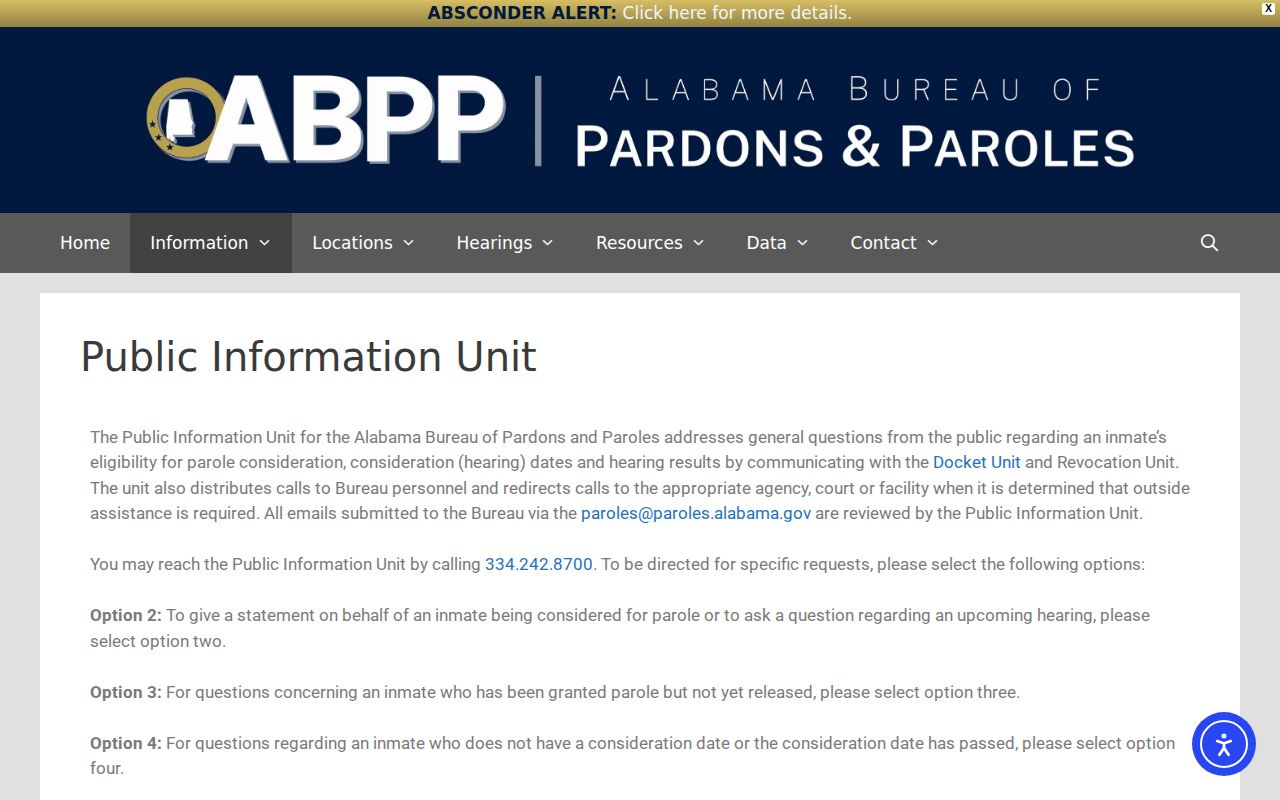
Source image from the project manifest: the ABPP Public Information Unit page is one of the official supervision contacts used for Jefferson County release questions.
Conditions, Violations, and Absconders
Supervision conditions are case-specific. Public pages may show hearing events, results, revocation activity, or court action, but they usually will not publish every reporting rule or condition online. If a person is described as an absconder, has a revocation matter, or appears to have a warrant tied to supervision, verify through the supervising agency and the court record instead of assuming the jail roster contains the whole story.
VINELink and Alabama VNS can help with custody-change alerts, but they serve different roles. VINELink is the custody-status and notification portal where participating data is available. Alabama VNS is narrower: it covers offenders convicted in Alabama and sentenced to ADOC custody, and it is not a general Jefferson County pretrial release feed. When the issue is a supervision change rather than a jail booking, use VINE/VNS as an alert layer and confirm the legal status through ABPP, ADOC, or the court.
How Jefferson County Supervision Ends
Supervision can end through expiration of the term, discharge, a Board or court action, or another case-specific order. A county jail Release Date only shows that the booking ended; it does not prove that parole, probation, community corrections, court costs, or a later revocation issue ended. For a formal record, use the custodian that created the action: ABPP for parole/probation records, ADOC for prison release and discharge records, and the appropriate Jefferson County court division for sentencing and probation orders.
Alabama public-record access is subject to statutes, exceptions, fees, custodian procedures, and redactions. For ABPP records, use the Request to View Public Records process and public.records@paroles.alabama.gov. For ADOC release records, ADOC requires written Form 23-A with the processing fee to its Public Records Coordinator. For local jail release facts, use the booking number, subject number, booking date, facility, and requested release field so the sheriff's office can identify the exact record.
Parole Hearings and Results
ABPP publishes Scheduled Parole Hearings, an Events calendar, Hearing Advancers, and Hearing Results. The Events menu includes scheduled hearings, cancellations, current-year results, and previous-year results. Research examples show Board parole and pardon hearings generally posted in Tuesday-through-Thursday blocks, but the page should be read as a posted schedule, not a guarantee that every week has a Jefferson County-related hearing.
Hearing Results posts can summarize the number of hearings and whether matters were granted, denied, or continued. A grant still needs release confirmation because ABPP's Public Information Unit is the better path for a person who has been granted parole but has not yet left custody. ABPP's parole FAQ ties eligibility consideration to Alabama Code § 15-22-28(e), with sentence, offense, county-jail time, good time, time served, and sentencing-court orders all affecting the calculation.
Local Reentry and Facility Routing
Jefferson County has local reentry and custody details that can affect how supervision research is read. The sheriff's IGNITE page describes education, accountability, and reentry preparation inside the local jail, including a GED testing site. That is local context for the county jail environment, not a guarantee about any individual person's release outcome.
Property, documents, and release logistics should be routed to the actual holding facility. Birmingham Police operates a separate city jail with its own custody services page and its own Tyler inquiry portal; a city detainee can be released from municipal custody without ever appearing in the Jefferson County sheriff roster. For county jail cases, Birmingham and Bessemer facilities share the sheriff's Tyler system, but court routing may still split between the Birmingham Division and the Bessemer Cutoff.