
Where Facility Releases Go
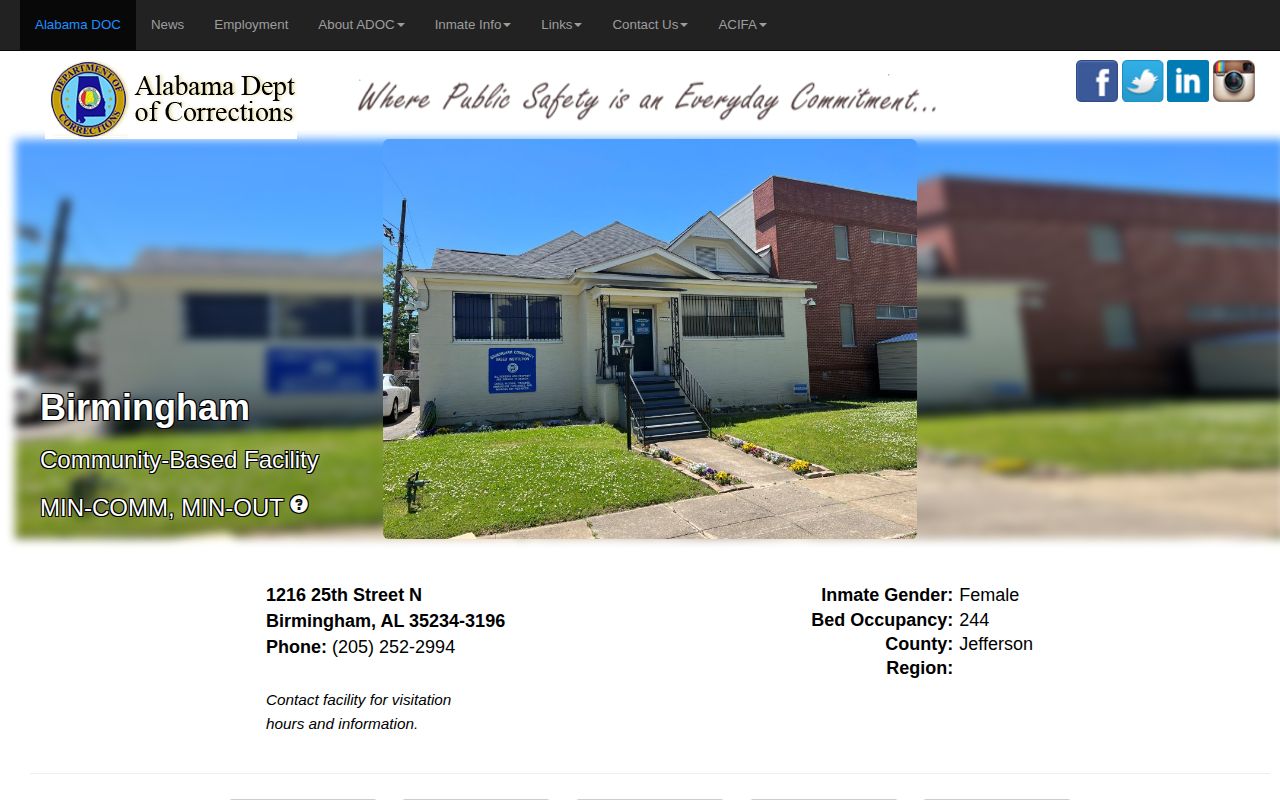
ADOC says the Birmingham Women's Community Based Facility and Community Work Center opened in 1973, houses female inmates in community-based custody, offers program services, and is classified as minimum custody. Release from this facility is a state-prison or ADOC community-custody release. It should not be treated as a county jail release from Birmingham or Bessemer.
While a person remains current in ADOC custody, ADOC's public inmate search can show state sentence and release-date fields. After release, ADOC says the public search contains only currently incarcerated inmates and does not provide historical data online. That limitation is central for this page: a person who no longer appears may have been released from ADOC, but the confirmation path becomes ADOC public records, ABPP, VNS, and court records.
Source view from the manifest: ADOC's Birmingham Women's facility page is the facility-specific source for this community work center.
Confirm an ADOC Community Release
Use the ADOC release route for this facility. The county jail roster is not the formal release record for a person leaving this state facility.
- Search ADOC by AIS number if available; otherwise search by first and last name.
- While the person is current, record the Minimum Release Date, Parole Consideration Date, County Jail Time, Good Time Received, Good Time Revoked, Sentence Date, Time Served, Total Term, and sentence type when shown.
- If the person no longer appears in ADOC search, do not assume there was no sentence; ADOC says historical data is not available online.
- Submit an ADOC public-record request for historical release or discharge information when a formal record is needed.
- Check ABPP, Alabama VNS, and the sentencing court for parole, probation, end-of-sentence, revocation, or court-order context.
| Question | Best channel |
|---|---|
| Current ADOC custody or minimum release date | ADOC inmate search while the person is still current. |
| Historical release/discharge record | ADOC Form 23-A public-record request to ADOC's Public Records Coordinator. |
| Parole or supervision status | ABPP public information, hearing results, and public-record request process. |
| Victim notification for ADOC-sentenced offender | Alabama VNS, not the county pretrial route. |
Facility Records and Contact
ADOC records are the state release path. ADOC says public-record requests must be submitted in writing on ADOC Form 23-A with the processing fee to the Public Records Coordinator. For questions about public records, ADOC lists public.records@doc.alabama.gov and 334-353-3883.
| Facility | Birmingham Women's Community Based Facility and Community Work Center |
|---|---|
| Type | ADOC minimum-custody community-based facility / work center |
| Facility address | 1216 25th Street N, Birmingham, AL 35234-3196 |
| Facility phone | 205-252-2994 |
| Population described by ADOC | Female inmates in community-based custody |
| ADOC mailing address | Alabama Department of Corrections, 301 S. Ripley Street, P.O. Box 301501, Montgomery, AL 36130-1501 |
| ADOC records questions | public.records@doc.alabama.gov or 334-353-3883 |
| VNS questions | Victims@AlabamaAG.gov or 800-626-7676 |
For parole records, ABPP accepts public-record requests through public.records@paroles.alabama.gov and maintains hearing schedules and hearing results. Those records may explain why an ADOC community-custody release occurred or why a granted parole still had processing steps before physical release.
When requesting a record for this facility, identify the request as an ADOC community-based facility or work-center release, not as a Birmingham city jail or Jefferson County jail release. Include the AIS number if known, full name, facility name, approximate custody dates, and the specific release or discharge information sought. If the question concerns parole hearing outcome, supervision, or a parole certificate/release issue, ABPP records or public information may be more responsive than ADOC central records alone.
About the Women's Facility
This facility's community-based and minimum-custody classification can create confusion for readers who expect a jail roster. A person may be in ADOC custody while participating in community work or program services, and the release record remains a state correctional record. The correct question is not whether the person appears in the Jefferson County jail, but whether ADOC, ABPP, VNS, and the sentencing court show the state custody or supervision outcome.
ADOC's Minimum Release Date is the closest public state field to a projected release date while a person is current. ADOC defines it as the earliest scheduled release to probation or end of sentence and warns that it can change because of disciplinaries, new cases from the circuit clerk, or sentence changes. Parole Consideration Date is different; it is a board consideration date, not a guaranteed release date.
Community custody also makes the word "release" easy to overread. A person may move between ADOC custody levels, work-center status, parole consideration, probation, or end-of-sentence release. The public page should therefore separate current custody status from final discharge. ADOC fields help while the person is current; after release, the durable path is written ADOC records, ABPP when supervision applies, VNS for eligible sentenced-offender notifications, and the sentencing court file.
Court and County Cross-Checks
If the sentence came from Jefferson County, the court file can explain county-jail time, the sentence order, probation terms, revocation, or dismissal of related charges. If the person was held in Jefferson County jail before ADOC, the county Tyler booking may show a local Release Date or transfer, but that county release does not prove release from ADOC custody. Use the county release search overview only to connect the local booking to the state record.
Jefferson County has Birmingham and Bessemer court divisions, so sentence-time or disposition questions should follow the division that handled the case. ADOC says County Jail Time is prepared by the sentencing county's circuit clerk, which means a release-date disagreement can require the clerk record, not just an ADOC search. Alacourt ACCESS can help match the criminal case to the sentence or revocation order behind the ADOC custody term.
VNS and ABPP Limits
Alabama VNS is narrower than many readers expect. It is for offenders convicted in Alabama and sentenced to ADOC prison, and it is not the right tool for a pretrial county detainee. For this women's facility, VNS may help with eligible ADOC-sentenced notification, but it should be checked alongside ADOC and ABPP rather than treated as the only release record.
ABPP does not provide a simple public parolee roster equivalent to a jail search. Use scheduled hearings, hearing results, public-information contacts, and formal ABPP public-record requests. If a hearing result says parole was granted but the person still appears in state custody, the release may still be moving through conditions, certificate, notice, or other processing steps.